Subterranean termite bait station array deployment fits structural defense requirements across Fulton County by establishing tamper-resistant monitoring cylinders flush with the turf line. In historic brick pier…
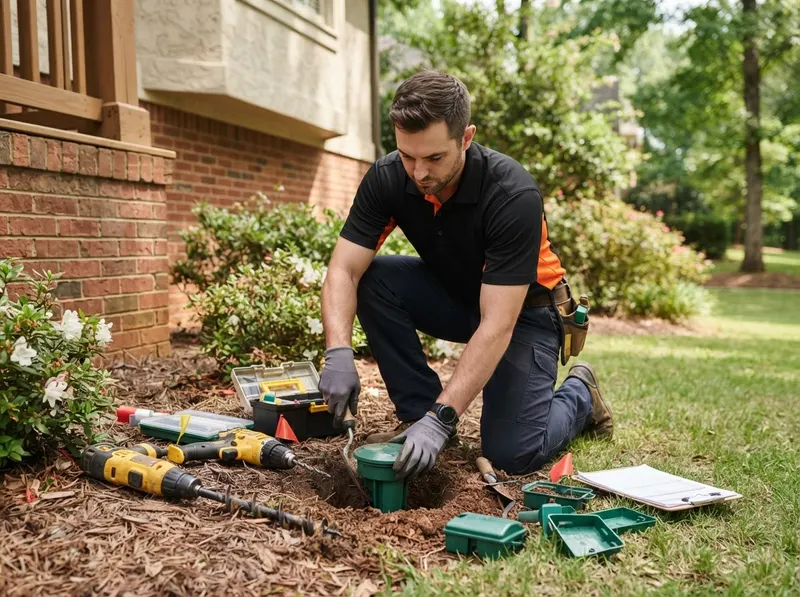
Subterranean termite bait station array deployment fits structural defense requirements across Fulton County by establishing tamper-resistant monitoring cylinders flush with the turf line. In historic brick pier foundations across Inman Park, Grant Park, and Cabbagetown, high soil moisture adjacent to crawlspace aprons attracts foraging worker termites tracking underground scent trails. Liquid chemical trenching often risks disturbing heritage root systems of specimen hardwoods or leaking through fractured stone masonry. An in-ground bait station array eliminates massive perimeter soil excavation by using targeted insect growth regulators that foraging termites ingest and transfer back to the central subterranean colony, arresting the molting cycle without flooding the soil with broad-spectrum volatile chemicals.
Modern slab installations across Midtown and Old Fourth Ward require deliberate spacing along hardscape edges, where concrete patios, carports, and paver walkways abut exterior sill plates. Specialized rotary hammer coring allows stations to seat cleanly within standard 3-inch access holes drilled through paved perimeters without destabilizing concrete slabs. Properties in Buckhead and Ansley Park containing extensive landscape beds with hardwood mulch require precise layout geometry, placing stations approximately 10 to 12 feet apart to ensure foraging zones overlap before workers breach foundation weep holes or foundation stucco wrap.
The trade-off between exterior bait stations and interior spot foam treatments centers on interception speed versus whole-colony suppression. Direct foaming treats localized timber damage inside finished drywall or heart pine framing in Virginia-Highland bungalows, halting immediate feeding inside an isolated wall cavity. However, spot treatments do not suppress the underground primary colony located up to 150 feet away in native red clay. A perimeter bait array addresses the external source pressure continuously, requiring annual or semi-annual maintenance intervals rather than intrusive interior wall drilling.
Every job gets a firm, written price after a free on-site visit.
Tell us about your subterranean termite bait station array job in Atlanta and we'll send a clear, written quote, usually the same day.
 Brass Lantern Pest Control