Subterranean termite liquid barrier treatment in Atlanta operates by establishing an undetectable zone of non-repellent termiticide in the immediate soil band around residential foundations. Subterranean termites…
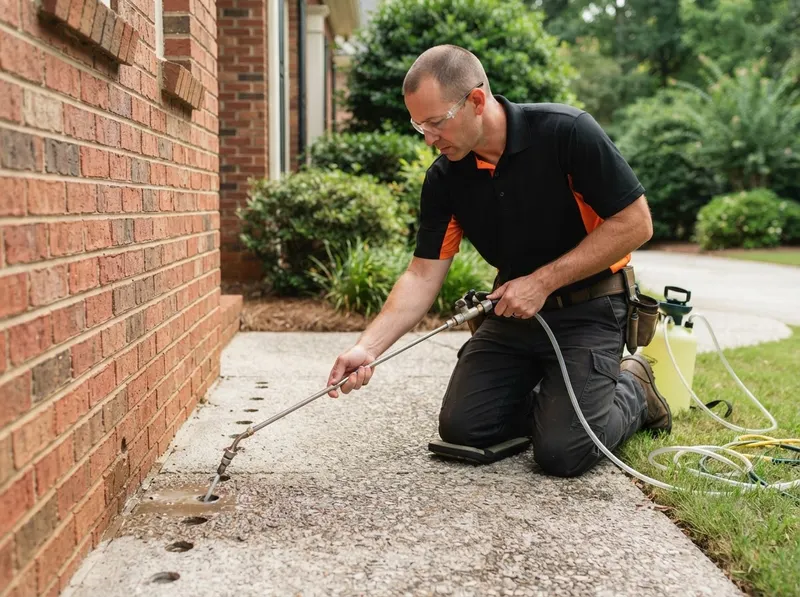
Subterranean termite liquid barrier treatment in Atlanta operates by establishing an undetectable zone of non-repellent termiticide in the immediate soil band around residential foundations. Subterranean termites construct mud exploration tubes upward from damp red clay soil into sills, joists, and stud bays. Unlike repellent pyrethroids that scatter colonies into interior cavities, modern non-repellent agents allow worker termites to pass freely through treated substrate. Exposed insects transfer the slow-acting compound throughout the colony through grooming behaviors, leading to population elimination rather than temporary avoidance.
Historic Atlanta architectural framing requires distinct execution strategies. Historic 1920s bungalows in Virginia-Highland and Inman Park feature brick-pier foundations and vented crawl spaces with exposed ground, requiring trenching along interior pier footings as well as outer curtain walls. Victorian framing in Grant Park and Cabbagetown frequently exhibits ground-to-wood clearance below 6 inches, where damp timber interfaces directly with topsoil near downspouts. Modern poured-concrete basements in Ansley Park and Buckhead, as well as multi-story row houses in Midtown and Old Fourth Ward, mandate precision masonry drilling through garage aprons, concrete patios, and porch slabs on 12-inch centers to saturate the underlying earth fill.
Liquid soil barriers suit properties with established mud shelter tubes, unencapsulated crawl spaces, or immediate structural vulnerabilities requiring zero construction disturbance to interior finishes. Bait stations offer an alternative perimeter monitor but require 60 to 180 days for termite interception and colony bait consumption. The trade-off between the two approaches involves upfront landscape disruption: liquid applications require excavating a narrow, shallow trench around perimeter shrubbery, while bait systems maintain undisturbed planting beds but require indefinite quarterly station monitoring. Subterranean liquid treatments establish an active protective zone lasting 5 to 10 years without requiring annual contract lock-ins.
Technicians calculate application volume using the standard architectural rate of 4 finished gallons of diluted liquid per 10 linear feet per foot of depth down to the top of the footer. 1. A 6-inch-wide by 6-inch-deep trench is excavated along all foundation walls. 2. Earth fill is saturated using low-pressure rod injection to reach sub-grade footings. 3. Solid masonry surfaces, including attached carports and HVAC pads, are drilled via 0.5-inch bits at 12-inch intervals. 4. Excavated soil is mixed with liquid termiticide, backfilled, and tamped flat to prevent animal exposure.
Every job gets a firm, written price after a free on-site visit.
Tell us about your subterranean termite liquid barrier treatment job in Atlanta and we'll send a clear, written quote, usually the same day.
 Brass Lantern Pest Control